
In California, rear-end collisions account for approximately 29% of all traffic accidents (OTS Annual Report, 2022). Most of these are caused by drivers failing to maintain safe following distances.
If you’ve ever navigated the chaos of the I-5 or battled rush hour on the 405, you know just how quickly California traffic can go from smooth sailing to full-stop panic. Rear-end accidents happen in a split second, and in most cases, the driver in the back is held responsible.
These types of crashes are among the most frequently reported across the U.S., and many could be avoided with one simple habit: keeping a safe following distance. This is why the three-second rule in California is critical not just for safety but also for legal protection.
What Is the Three-Second Rule?
The three-second rule is a simple way to check if you’re following another vehicle at a safe distance. Just pick a fixed object on the road ahead—like a sign or overpass—then count “one-thousand one, one-thousand two, one-thousand three” after the car in front of you passes it. If you reach the same spot before finishing the count, you’re too close and should slow down to create more space.
How to Apply the Three-Second Rule Like a Pro:
So, you know what the three-second rule in driving is, but how do you use it when you’re on a busy California freeway, tailgated by someone on their phone and boxed in on both sides?
- Pick a Landmark: Look ahead and find something fixed, like a traffic sign, tree, or overpass.
- Watch the Car in Front: As soon as the rear of their car passes the landmark.
- Start Counting: Say out loud, “One thousand one… one thousand two… one thousand three.”
- Adjust if Needed: If you pass the same landmark before you hit “three,” ease off the gas and create more space.
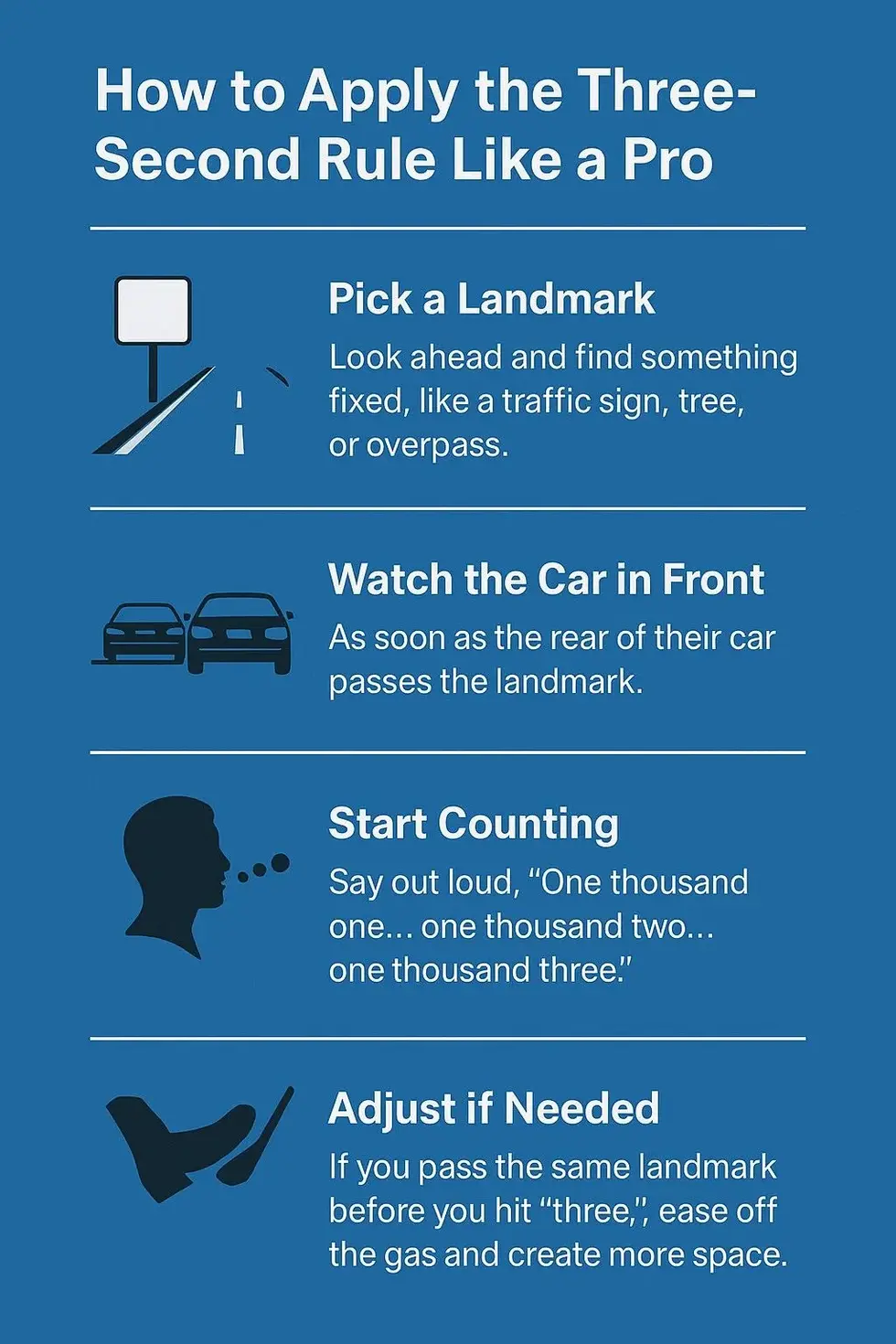
This rule is essential in ensuring you keep a reasonable following distance, especially during rush hour madness in places like LA or San Diego.
How Far Is 3 Seconds, Really?
|
Speed (mph) |
Distance Traveled in 3 Seconds |
Approx. Car Lengths |
|
30 mph |
132 feet |
~9 car lengths |
|
55 mph |
242 feet |
~16 car lengths |
|
70 mph |
308 feet |
~21 car lengths |
Quick Tip Box:
Always maintain 3 seconds minimum in ideal conditions and add 1 extra second for every driving hazard (rain, tailgating, heavy load).
California Law: Legal Implications of Tailgating
CA Vehicle Code 21703 – Following Too Closely
In rear-end collisions, the rear driver is presumed at fault under California law—unless clear evidence proves the front driver acted dangerously or abruptly.
Under California Vehicle Code Section 21703:
“The driver of a motor vehicle shall not follow another vehicle more closely than is reasonable and prudent, having due regard for the speed of such vehicles and the traffic upon, and the condition of, the roadway.”
Violations may result in:
Violating the three-second rule can lead to a tailgating ticket, a reckless driving charge, and greater liability in accidents. It may also result in higher insurance premiums due to increased risk.
- Tailgating ticket
- Reckless driving charge
- Increased liability in accidents
- Higher insurance premiums
Why the Rule Evolved from 2 to 3 Seconds
Initially, safety instructors promoted the two-second rule, but research proved it was no longer adequate for modern driving conditions.
Why It Changed:
- Faster vehicles and shorter reaction times
- Increased distracted driving
- Heavier traffic on freeways
- More aggressive drivers
Today, both the National Safety Council (NSC) and the California DMV recommend the three-second rule as a minimum following distance under ideal conditions.
The Science Behind the Three-Second Rule
The three-second rule in driving is grounded in real-world reaction data and vehicle physics—it’s not just a “good idea,” it’s math in motion.
|
Component |
Time (Seconds) |
Explanation |
|
Perception Time |
1.75 |
Time to detect a hazard |
|
Reaction Time |
0.75 |
Time to move foot from gas to brake |
|
Safety Buffer |
0.50 |
To account for distractions and unexpected delays |
|
Total |
3.00 |
Minimum needed to avoid a collision |
Frequently Asked Questions (FAQs)
What should I do if another driver cuts into my three-second following distance?
It happens frequently, especially on busy California freeways. If another driver suddenly merges into your lane and closes your gap, just ease off the gas and re-establish your three-second following distance. Don’t tailgate them out of frustration; it could escalate the situation and put you at risk for a rear-end collision.
Is the three-second rule in California legally enforceable?
Technically, no law says, “You must follow the three-second rule,” but under California Vehicle Code § 21703, drivers are required to maintain a reasonable and prudent following distance. If you’re involved in an accident or stopped by law enforcement, violating this rule could result in a citation for following too closely, especially if you rear-end another vehicle.
How does the three-second rule affect car insurance claims in California?
If you’re involved in a rear-end accident and failed to follow the three-second rule, your insurance provider may hold you liable. This could raise your premiums and impact claim eligibility. However, if you can prove the other driver acted recklessly—like cutting you off—you may still have a valid defense.
Helpful resource: How to Fight a 50/50 Insurance Claim Decision in California
How Fassonaki Law Firm, P.C. Can Help After a Rear-End Accident in California
If you were injured in a rear-end accident or wrongly blamed, don’t face it alone.
Fassonaki Law Firm, P.C., is here to protect your rights.
We’ll guide you through California’s three-second rule laws and the insurance claims process.
Call us today at 323‑524‑8994 for a free consultation with an experienced rear-end accident lawyer in California.