
In California, the average post-concussion syndrome settlement value for a car accident ranges from $10,000 to more than $1,000,000. The exact amount depends on the severity of the injury, medical needs, and long-term effects.
Post-concussion syndrome (PCS) develops after a traumatic brain injury, often from a car crash. Unlike a typical concussion, PCS can last for months or even years. Victims may face headaches, memory loss, fatigue, and emotional struggles that disrupt work and daily life.
If you are dealing with PCS after a crash, working with our experienced car accident lawyers in Los Angeles can make the difference in securing the full compensation you deserve.
How to Get the Compensation I Deserve After a Concussion?
To qualify for a concussion or PCS settlement in California, you must show medical evidence that the accident directly caused your symptoms. State law also gives you only two years to file a personal injury claim, so it’s important to act quickly.
At Fassonaki Law Firm, P.C., we fight for maximum settlements in PCS cases. Call 323-524-8994 today for a free consultation; we are available 24/7 and charge no fees unless we win.
What Is the Average Settlement for a Concussion in California?
In California, the average settlement for a concussion can range from $10,000 to over $1,000,000, depending on the severity of symptoms and long-term impact.
Mild Concussions/Short-Term PCS: Settlements often fall between $10,000 and $50,000. These cases typically involve temporary symptoms, short-term medical care, and minimal lost wages.
Moderate PCS Cases: When symptoms last for months, settlements may range from $50,000 to $250,000, especially if ongoing therapy or missed work is involved.
Severe PCS and Long-Term Disability: Cases with permanent symptoms, major medical costs, or lost earning capacity can reach $500,000 to $1,000,000+. Some California jury verdicts have exceeded these amounts when daily life and income are deeply affected.
Disclaimer: The figures above are general estimates based on past California cases. Your settlement amount may be higher or lower depending on medical evidence, liability, and insurance coverage.
Can I Still Sue If My PCS Symptoms Appeared Weeks After the Accident?
Yes, you can still sue for post-concussion syndrome (PCS) in California, even if your symptoms appeared days or weeks after the crash. Delayed onset is very common with PCS.
Medical experts, including the American Academy of Neurology and the CDC, explain that concussion symptoms do not always show up immediately. Headaches, dizziness, fatigue, and memory problems may only appear later as the brain struggles to heal. This is why PCS is often called an “invisible injury.”
California law supports your right to file a PCS lawsuit as long as you act within the statute of limitations. Under California Code of Civil Procedure § 335.1, you usually have two years from the date of the accident to file a personal injury claim. If a government vehicle or agency was involved, you must first file an administrative claim within six months under Gov. Code § 911.2.
How to Overcome Insurance Company Denials in PCS Cases?
Many people with post-concussion syndrome (PCS) hear the same line from insurance adjusters:
“Your symptoms aren’t real” or “This is just a pre-existing condition.”
This happens because PCS is an “invisible injury.” It doesn’t always show up on a CT scan or MRI. But that doesn’t mean it isn’t real, and California courts recognize it.
Here’s how we prove PCS when the insurance company pushes back:
Medical Experts Speak for You: Neurologists and neuropsychologists explain to the court that PCS is a well-documented medical condition.
Scientific Testing: Cognitive exams, memory tests, and balance evaluations show the impact PCS has on your daily life.
Consistent Medical Records: Every doctor visit, therapy session, and prescription helps show a clear pattern of symptoms.
Real-World Evidence: Employer notes, school records, or even family observations confirm that PCS is affecting your ability to function.
How to Maximize Your Post-Concussion Syndrome Settlement in California?
Getting the maximum compensation for post-concussion syndrome (PCS) is not just about filing a claim. It’s about building the right medical and legal foundation from the very beginning.
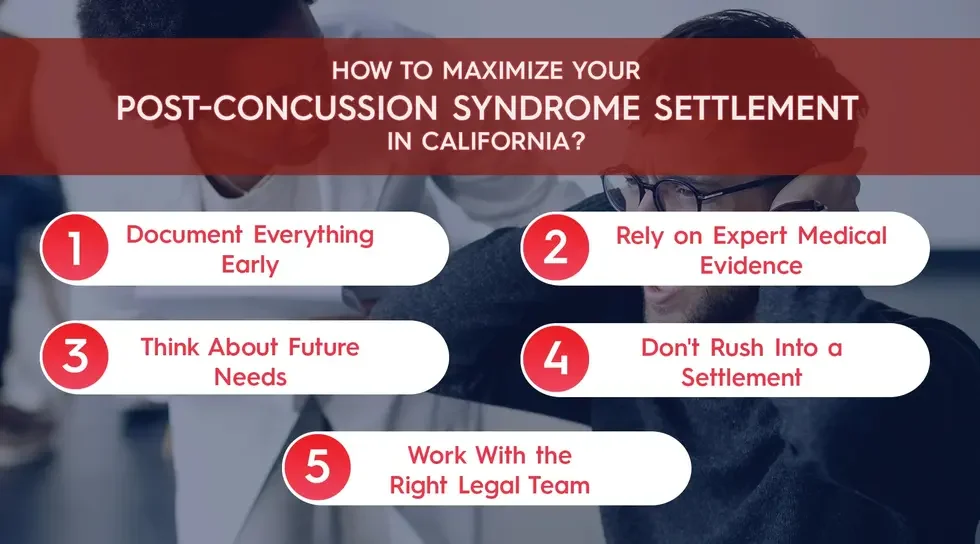
Here are the most important steps you should take:
Document Everything Early: Keep all your medical bills, therapy notes, and prescriptions in one place. Consistent records show how PCS affects your health over time and make your claim stronger.
Rely on Expert Medical Evidence: Specialists like neurologists and neuropsychologists can back up your symptoms with professional reports. The Mayo Clinic reports that about 15–20% of concussion patients develop PCS, even when CT or MRI scans look normal.
Think About Future Needs: Don’t just focus on today’s expenses. PCS can last months or years. Life care planners and economists can estimate future treatment costs and lost income so you don’t end up underpaid.
Don’t Rush Into a Settlement: Insurance companies often try to close cases fast with low offers. If you accept too quickly, you may be stuck paying out of pocket later. Always let an attorney review any offer before you decide.
Work With the Right Legal Team
At Fassonaki Law Firm, our car accident lawyers in Los Angeles know how to prove PCS and fight for the full compensation you deserve. We also know how to negotiate policy limits and pursue a fair settlement for a concussion in a car accident.
Factors That Affect the Value of a PCS Settlement in California?
The amount of money you can recover for post-concussion syndrome (PCS) depends on several factors. Each one plays a role in how the insurance company or court values your case.
Severity and Duration of Symptoms
The longer PCS symptoms last, the higher the potential settlement. Ongoing headaches, memory problems, or fatigue usually increase the value of a claim.Impact on Daily Life and Work
If PCS limits your ability to work, study, or enjoy everyday activities, it directly raises the settlement value. Courts and insurers look closely at how much your independence has been reduced.Medical Expenses
Settlements must cover past and future medical bills. This includes ER visits, neurologist appointments, therapy, medications, and rehabilitation.Future Lost Income
If PCS keeps you from working full-time or limits your career options, economists can calculate the value of your future lost earnings. This can significantly increase compensation.Insurance Policy Limits
In California, minimum coverage is low ($15,000 per person / $30,000 per accident). If the at-fault driver’s policy is limited, your own uninsured/underinsured motorist (UM/UIM) coverage may come into play.Comparative Fault Rule
California follows pure comparative negligence. This means your settlement can be reduced if you were partly at fault for the accident. For example, if you were found 20% at fault, your compensation would be reduced by 20%.
What Could a Post-Concussion Syndrome Settlement Include?
A PCS settlement in California is designed to cover both your financial losses and the personal impact of the injury. Here are the main categories of damages you may recover:
Medical Expenses: This includes ER visits, neurologist appointments, cognitive testing, medications, physical therapy, and ongoing rehabilitation. Future medical care is also considered if PCS symptoms are long-term.
Lost Income: If PCS forces you to miss work or cut hours, you can claim the wages you lost. In more serious cases, economists may calculate future lost earning capacity when PCS limits your career options.
Pain and Suffering: California law allows compensation for physical pain, emotional distress, memory problems, fatigue, anxiety, and other non-economic damages that PCS victims experience.
Property Damage: If your vehicle or belongings were damaged in the accident, those repair or replacement costs are included.
Other Damages: In certain cases, settlements may also include rehabilitation costs, home modifications, or assistive devices if PCS causes long-term impairment.
California Car Accident Laws Affecting PCS Settlement Amounts
Several California laws directly affect how much compensation you can receive for post-concussion syndrome (PCS) after a car accident. Knowing these rules helps protect your rights.
Statute of Limitations (CCP § 335.1): You usually have two years from the date of the accident to file a PCS lawsuit in California. If you miss this deadline, you lose your right to claim compensation.
Government Claims (Gov. Code § 911.2)
If the at-fault driver worked for a city, county, or state agency, you must file an administrative claim within six months before going to court.Comparative Fault Rule (Li v. Yellow Cab, 1975)
California follows pure comparative negligence. This means your settlement will be reduced by your percentage of fault. For example, if you are 25% at fault, your compensation is reduced by 25%.Insurance Requirements (Vehicle Code § 16056)
California requires drivers to carry minimum liability coverage of $15,000 per person, $30,000 per accident, and $5,000 for property damage. If damages are higher, your uninsured/underinsured motorist (UM/UIM) coverage may help cover the difference.
Real-Life Examples of PCS Settlements in California
Looking at past cases can help you understand how post-concussion syndrome (PCS) settlements are valued in California. Here are two examples:
This was a car accident case in which the defendant allegedly strayed beyond the centerline, causing a broadside collision with the plaintiff. The plaintiff, a middle-aged female, claimed injuries such as cranial nerve damage, occipital neuralgia, persistent migraine headaches, and an unnamed shoulder injury. A jury in Los Angeles County awarded $40,000, including $10,000 for future medical costs.
The Process for a Car Accident Concussion Settlement
If you are filing a PCS lawsuit in California, it helps to know what the process looks like. Here’s the typical path most cases follow:
Initial Consultation: You meet with a car accident lawyer in Los Angeles to review your accident and medical history. The lawyer explains your rights and gives you an honest assessment of your case.
Evidence Collection: Our legal team gathers police reports, medical records, therapy notes, wage loss proof, and witness statements. This documentation becomes the backbone of your PCS claim.
Medical Evaluation: Specialists such as neurologists and neuropsychologists confirm your PCS diagnosis and its impact on your life. Their reports are critical in proving your injury.
Filing the Insurance Claim: Your attorney prepares a demand package with all damages included medical bills, future care, lost income, and pain and suffering. This is submitted to the at-fault driver’s insurance company.
Negotiation: The insurance company usually makes a low first offer. Our lawyer negotiates aggressively to push for a fair settlement for concussion in a car accident.
Litigation if Needed: If the insurer refuses to settle fairly, your attorney files a lawsuit in California courts. This may lead to mediation, arbitration, or trial before a jury.
How Can I Prove My Future Medical Needs and Lost Income?
One of the biggest concerns in a PCS lawsuit in California is proving what your future will look like. Post-concussion syndrome can last months, years, or even a lifetime. That means your settlement must cover not only today’s bills but also tomorrow’s costs.
Here’s how future damages are proven:
1- These are medical experts who prepare detailed reports about what care you will need in the future. This may include physical therapy, cognitive rehabilitation, medications, or even home modifications if your PCS is severe.
2- An economist works with our lawyer to calculate the value of your lost income. If PCS limits your ability to work full-time, reduces your career options, or forces early retirement, they project the financial loss over your lifetime.
3- Neurologists and neuropsychologists explain how PCS affects your ability to function daily. Their testimony links your ongoing limitations to the original accident.
4- Consistent medical records, work restrictions, and therapy notes support the claim that your PCS symptoms will continue into the future.
What If I Can’t Handle a PCS Lawsuit on My Own?
Living with post-concussion syndrome (PCS) is exhausting. Fatigue, brain fog, and memory problems can make the thought of a lawsuit feel impossible. Many clients worry they won’t have the energy to keep up with the legal process.
The good news is you don’t have to. An experienced PCS lawyer in California takes on the heavy lifting:
Communicating with insurance companies
Collecting medical records and accident evidence
Working with experts like neurologists and life care planners
Filing all legal documents before deadlines
Negotiating for the highest settlement possible
Your role is simple: focus on medical treatment and keep Fassonaki law firm lawyer updated about your symptoms. Everything else, from paperwork to court appearances, is managed for you.
What’s the Deadline for My PCS Case in California?
In California, the deadline for filing a post-concussion syndrome (PCS) lawsuit is usually two years from the date of the accident. This is called the statute of limitations under California Code of Civil Procedure § 335.1.
If your case involves a government agency, for example, a city bus or county vehicle, the deadline is even shorter. You must file an administrative claim within six months under Government Code §911.2 before you can take the case to court.
Missing these deadlines means you lose the right to seek compensation, no matter how strong your PCS claim may be.
Why Strong Medical Proof Can Make or Break Your PCS Claim
When it comes to post-concussion syndrome (PCS) settlements in California, medical evidence is everything. Unlike broken bones or visible injuries, PCS is often hidden, which gives insurers the chance to argue your symptoms don’t exist. That’s why proving your condition requires more than just saying you feel unwell.
Here’s what makes a PCS claim stronger:
Advanced Diagnostic Testing: MRIs, neurocognitive exams, and balance assessments can highlight issues with memory, focus, or coordination. These tests translate your symptoms into measurable data insurers and juries can’t ignore.
Specialist Opinions That Carry Weight: Neurologists, neuropsychologists, and rehabilitation experts connect the dots between your accident and your PCS. They can explain how the injury impacts your daily life, your emotional health, and your future care needs.
How Our Los Angeles Legal Team Builds Winning PCS Cases
At Fassonaki Law Firm, we understand that PCS cases are different from other car accident claims. Our team works directly with respected medical specialists, gathers every record, and documents how your injury affects your life today and in the future.
We handle the insurance companies, court filings, and negotiations ; so you can focus on healing. With our Los Angeles car accident lawyers on your side, you’ll have both the legal and medical support needed to pursue the maximum settlement.
FAQs on Post-Concussion Syndrome Settlements
1. How much is a settlement for post-concussion syndrome?
In California, PCS settlements can range from $10,000 to over $1,000,000. The amount depends on symptom severity, medical costs, lost wages, and how the condition affects daily life.
2. How much compensation can I get for post-concussion syndrome?
Compensation includes more than medical bills. A PCS claim may cover lost income, future medical care, pain and suffering, and reduced quality of life. Severe cases with long-term disability usually receive higher compensation.
3. Does post-concussion syndrome qualify for disability?
Yes. If PCS symptoms such as memory loss, fatigue, or headaches prevent you from working, you may qualify for short-term or long-term disability benefits. In some cases, PCS can also meet the Social Security Disability standard.
4. How do I prove post-concussion syndrome for insurance?
You’ll need strong medical evidence. Neurologists and neuropsychologists can perform tests that show cognitive and balance problems. Consistent medical records, therapy notes, and expert reports link PCS to your accident and strengthen your claim.
5- How do I prove PCS when my scans look normal?
Our lawyer will rely on neurologists, neuropsychologists, and specialized tests like cognitive exams and balance assessments. This medical evidence shows the real impact of PCS.