
Many accident victims in California share the same fear: “If I agree to mediation, will I be stuck with whatever happens?” This concern is understandable.
Take the example of a car accident where both drivers argue over who was at fault. The injured victim needs medical care and lost wages reimbursed quickly, but the insurance company keeps delaying, insisting the victim may share responsibility. Rather than waiting months or even years for a jury trial, the parties agree to personal injury mediation. They sit down with a neutral mediator to discuss options in a private and confidential setting, which often becomes the turning point in personal injury settlement negotiations in California. Importantly, nothing becomes binding until both sides voluntarily sign a written settlement agreement.
At Fassonaki Law Firm, P.C., our Los Angeles car accident lawyers help victims navigate personal injury mediation, making sure the process protects their rights and leads to the compensation they deserve.
What Is Mediation in Personal Injury Cases?
When an accident victim in California files a personal injury claim, the road to recovery is rarely simple. Insurance companies often dispute liability, minimize damages, or delay settlement offers. Going to trial is an option, but it comes with significant costs, stress, and the risk of an unpredictable jury verdict. This is where mediation in personal injury cases comes in as an effective alternative.
Mediation is a form of Alternative Dispute Resolution (ADR) designed to help injured victims and defendants resolve disputes without stepping into a courtroom. Unlike a trial, where a judge or jury decides the outcome, mediation is centered on voluntary negotiation guided by a neutral third party called a mediator.
Here’s what mediation sets apart:
Mediator Neutrality: The mediator is not a judge, arbitrator, or advocate for either side. Their role is to remain neutral, facilitate discussion, and ensure both parties are heard. Mediators often “reality-test” positions, pointing out strengths and weaknesses so each side understands the risks of going to trial.
Integrative vs. Distributive Bargaining: Mediators may use integrative bargaining (finding solutions that benefit both sides, such as structured payment schedules) or distributive bargaining (focusing on dividing a settlement amount fairly). This flexibility makes mediation especially valuable in personal injury disputes.
Private and Confidential: Everything discussed in mediation remains confidential. California law protects this under Evidence Code § 1119, which means offers, admissions, or negotiations cannot be later used in court. This “without-prejudice privilege” encourages open, honest dialogue.
Contrasting Arbitration: Unlike arbitration, another form of ADR, mediation is non-binding unless a written agreement is signed. Arbitration can result in a decision that is binding on the parties, similar to a court ruling, whereas mediation leaves control with the accident victim and defendant.
Likewise, personal injury mediation provides accident victims with a safe, controlled, and confidential environment to pursue fair compensation. Whether the case involves a car accident settlement, a slip-and-fall injury, or a catastrophic personal injury lawsuit mediation, mediation allows for creative, practical solutions without the burden of trial.
Is Mediation Legally Binding in Personal Injury Cases?
One of the most common questions clients ask after an accident is, “Is mediation legally binding in personal injury cases?” The answer under California law is straightforward: the mediation process itself is not legally binding, but the written settlement agreement signed at the end can be.
Then, when is mediation non-binding?
During mediation, everything said, whether it’s a settlement offer, a statement about liability, or a discussion of damages, remains non-binding. The mediator has no authority to force a settlement. You, as the accident victim, maintain full control over whether you accept or reject any proposed resolution.
This safeguard exists for a reason: mediation is about creating space for open negotiation, not about imposing outcomes. You can discuss numbers, test strategies, and evaluate offers without worrying that your words will later be used against you.
When Does Mediation Become Binding?
Mediation becomes binding only when both parties sign a written settlement agreement. At that point, the agreement functions as a contract under California law and is enforceable in court.
California law provides clear statutory authority for this:
Evidence Code § 1123 makes mediation settlement agreements admissible if they are signed by the parties and expressly state that they are binding.
California Code of Civil Procedure § 664.6 allows courts to enforce settlement agreements reached in mediation as judgments.
In practice, this means that until you sign, mediation is just a conversation. Once you sign, it becomes a legally enforceable contract.
Before signing (mediation) = confidential discussion with no legal effect.
After signing (mediation) = enforceable settlement agreement is protected under California law.
The next important question to understand is how mediation compares to taking your personal injury case all the way to trial.
Mediation vs. Trial in Personal Injury Lawsuits
When you have been injured in a car accident, slip-and-fall, or any other personal injury case in California, you typically have two paths to resolve your claim: mediation or trial. Both processes can lead to compensation, but they are very different experiences. Understanding these differences is crucial when deciding how to pursue your case.
1- Time and Cost
Trial: Personal injury trials in California courts can take 1–3 years or longer to reach. Trials often involve years of litigation and significant legal costs. Many accident victims also wonder how much car accident lawyers charge in California, and mediation can help keep overall expenses much lower compared to taking a case to trial.
Mediation: By contrast, mediation can often resolve disputes in a single day or over the course of a few sessions. There is no jury selection, no courtroom delays, and no lengthy discovery battles. Legal costs are significantly reduced because the focus is on negotiation, not litigation.
It’s also worth noting that California courts frequently order mandatory settlement conferences before trial. While not the same as mediation, these conferences share many features and reinforce the state’s preference for resolving cases outside the courtroom.
2- Control vs. Jury Risk
Trial: In a trial, the outcome is determined by a judge or jury. No matter how strong your evidence may seem, juries can be unpredictable. A sympathetic jury might award a very high verdict, but another might decide against you entirely or award damages far lower than expected. This uncertainty makes the trial a gamble.
Mediation: Mediation also gives you a chance to test strategies and practice how to negotiate a fair settlement with your insurance adjuster after a car accident, something that becomes much harder once a trial begins.
For example, in a recent (T-Bone) auto accident settlement, a jury might sympathize with the defense and reduce damages due to perceived comparative negligence. In mediation, your attorney can negotiate directly with the insurance company and ensure your voice is heard.
3- Emotional Stress and Privacy
Trial: Trials are public. Your medical history, lost wages, and even your testimony about pain and suffering become part of the public record. Court appearances can also be stressful, forcing you to relive traumatic events under cross-examination.
Mediation: Mediation is private and confidential. Under California Evidence Code § 1119, nothing you say can be used in court if mediation fails. The process is designed to be less adversarial, giving you the chance to negotiate in a calmer, more respectful environment.
4- Jury Verdicts vs. Settlement Agreements
Another key difference is finality.
Jury Verdicts: Jury verdicts can be appealed, which may delay compensation for years. Even after winning, you may face motions to reduce damages or challenges to liability.
Mediation Settlements: Settlements reached in mediation are enforceable contracts. Once signed, the defendant or their insurance company must pay according to the agreed terms. There is no appeal, no further litigation, and no uncertainty.
Step-by-Step Mediation Process in California Personal Injury Cases
For an accident victim, mediation may feel less intimidating than a trial, but it still follows a structured process. Understanding each stage helps you know what to expect and how to prepare. Here’s a detailed look at how personal injury mediation typically unfolds in California.
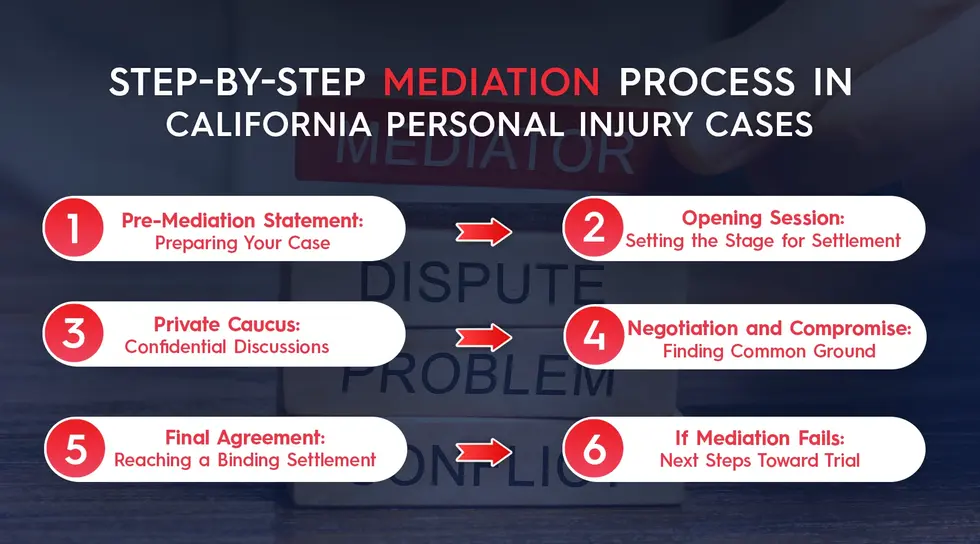
1. Pre-Mediation Statement
Before the mediation session begins, both sides usually submit a pre-mediation statement (also called a pre-mediation brief). This document outlines:
The facts of the accident (e.g., car accident, slip-and-fall, truck crash).
Liability issues, including arguments about comparative negligence if fault is disputed.
Damages such as medical bills, lost wages, pain and suffering, and future treatment needs.
Supporting evidence like police reports, witness statements, photographs, and medical records.
This statement is not filed with the court; it is confidential and shared only with the mediator and sometimes with the opposing party. A well-prepared pre-mediation brief strengthens your position and allows the mediator to understand the full scope of your claim.
2. Opening Session
The mediation begins with a joint opening session. Both parties, the injured victim (plaintiff) and the defendant (often represented by an insurance company), sit down with the mediator.
During this stage:
The mediator explains the rules and emphasizes confidentiality under California Evidence Code § 1119.
Each side makes an opening statement. For example, the plaintiff’s attorney may outline the seriousness of the injuries, lost wages, and emotional trauma, while the defense may argue comparative fault or question the extent of damages.
The mediator sets the tone as a neutral facilitator, reminding everyone that the goal is settlement, not argument.
Case Example: In a personal injury lawsuit mediation involving a pedestrian accident in Los Angeles, the plaintiff’s lawyer might emphasize the defendant driver’s negligence in running a red light, supported by traffic camera footage and police report.
3. Private Caucus
After the opening session, the mediator typically separates the parties into different rooms for private caucuses. These sessions are confidential; what you say to the mediator cannot be shared unless you authorize it.
In caucus, the mediator may:
Explore settlement ranges by testing each side’s flexibility.
Highlight risks, such as how a jury might perceive conflicting testimony.
Encourage integrative bargaining (creative solutions) instead of purely distributive bargaining (haggling over numbers).
This confidential back-and-forth helps narrow the gap between offers.
4. Negotiation and Compromise
This is the heart of mediation. Offers and counteroffers are exchanged until the parties move closer to agreement. The mediator may use techniques such as:
Bracketed offers: Each side proposes a settlement range.
Mediator’s proposal: If talks stall, the mediator may suggest a number both sides could live with.
Settlement options: The parties may consider structured settlements (periodic payments), mini/maxi agreements (setting a high and low limit), or, in some cases, multi-defendant agreements when more than one party is involved.
5. Final Agreement
If the parties reach an agreement, the mediator drafts a settlement memorandum or written settlement agreement. This document:
States the settlement amount.
Defines the payment timeline (in California, insurers must usually pay within 30 days).
Specifies how funds will be allocated (medical liens, attorney’s fees, and the net recovery for the victim).
Clarifies that the agreement is binding under California Evidence Code § 1123 and enforceable in court under CCP § 664.6.
Once signed, this agreement has the same force as a court judgment.
6. If Mediation Fails
Not every mediation ends with a settlement, and that is normal. If mediation fails:
Negotiations can continue informally between the attorneys.
The case proceeds toward trial.
Importantly, everything said remains confidential and cannot be used in court.
Can Rescission Be Part of the Mediation Process?
One of the most overlooked issues in personal injury lawsuit mediation is whether a settlement agreement can later be canceled or rescinded. This matters because once you sign a mediation settlement, it becomes a binding contract. But under California law, rescission may be possible in very limited circumstances.
California Grounds for Rescission
Under California Civil Code § 1689, rescission is allowed only when specific legal grounds exist, such as
Fraud or misrepresentation: If one party lied about material facts (e.g., hiding the extent of insurance coverage).
Mistake of fact: If both parties were unaware of critical facts at the time of settlement (e.g., later discovery of a serious undisclosed injury).
Duress or undue influence: If a party was pressured or coerced into signing.
Failure of consideration: If one side doesn’t perform as agreed (e.g., the insurer fails to pay).
Advantages vs. Disadvantages of Mediation in Personal Injury Settlements
|
Advantages of Mediation |
Disadvantages of Mediation |
|
1- Cost-Effective: Mediation is far cheaper than trial, saving accident victims money on court costs, expert witness fees, and prolonged litigation. |
Non-Binding Until Signed: Mediation is not binding until a written settlement agreement is signed (per California Evidence Code § 1123). Parties can walk away, leading to wasted time. |
|
2- Faster Resolution: Most personal injury lawsuit mediations are resolved in weeks or months, while trials can take years. |
Risk of Lowball Offers: Insurance adjusters may use mediation to push unfair settlements, hoping victims accept less without attorney guidance. |
|
3- Confidential Process: Protected under California Evidence Code § 1119, mediation ensures privacy. Sensitive details about injuries or finances never become public record. |
No Guaranteed Settlement: If parties fail to agree, the case moves to trial, and all mediation efforts may feel like a dead end. |
|
4- Party Control: Unlike a trial (where a jury decides), the victim and insurer control the outcome. The mediator cannot impose a decision. |
Power Imbalance: Without a lawyer, accident victims may feel pressured against well-prepared defense attorneys or insurance companies. |
|
5- Creative Solutions: Options like structured settlements, mini/maxi agreements, or multi-defendant agreements allow flexibility beyond simple lump-sum payouts. |
Potential Emotional Strain: Facing the opposing party in mediation can be stressful, especially for victims of traumatic accidents. |
Get help from an experienced Los Angeles personal injury attorney.
Still wondering, “Is mediation legally binding in personal injury cases?” At Fassonaki Law Firm, P.C., our attorney has helped the great number of accident victims in Los Angeles and across California resolve their claims through mediation without sacrificing the compensation they deserve.
Mediation often saves time, reduces stress, and keeps your case private compared to a trial, allowing you to focus on recovery while we handle the legal fight. Our attorney is committed to protecting your rights and securing the maximum settlement possible.
Call us today at 323-524-8994 to schedule your free consultation with a trusted Los Angeles personal injury lawyer.
Mediation in Personal Injury Cases – FAQs
1- How long does mediation take in a personal injury case?
Most personal injury mediations in California last between 4–8 hours in a single day. However, cases involving serious injuries or multiple defendants may require more than one session to settle.
2- Can I reject a mediation settlement offer?
Yes, you are never forced to accept a settlement in mediation. If the offer is too low or unfair, you can walk away and continue your lawsuit toward trial.
3- Do insurance companies settle faster in mediation?
Insurance companies often settle faster in mediation because it helps them avoid the expense and uncertainty of a jury trial. This can benefit accident victims by speeding up compensation for medical bills and lost wages.
4- What happens if mediation fails in a personal injury lawsuit?
If mediation doesn’t result in an agreement, your case simply proceeds to trial. Nothing said during mediation can be used against you later in court under California Evidence Code § 1119.
5- Do I need a lawyer for personal injury mediation in Los Angeles?
Yes, having a Los Angeles personal injury lawyer is critical in mediation. An attorney ensures you don’t accept a lowball settlement, calculates your true damages, and fights for the maximum recovery you deserve.
6- How do attorneys typically calculate their fees in mediation settlements?
Most personal injury attorneys in California work on a contingency fee basis, usually taking around 33–40% of the total recovery if a case settles before litigation.