
According to the Centers for Disease Control and Prevention (CDC), more than 2.8 million Americans sustain a traumatic brain injury each year. For victims in California, proving a brain injury in a legal claim requires strong evidence, expert testimony, and an attorney who understands the complex nature of these cases.
If your TBI was caused by a crash, fall, or another act of negligence, you don’t have to face the medical bills and legal fight alone. Working with our experienced traumatic brain injury lawyer can make the difference between an insurance company downplaying your injury and securing the full compensation you deserve.
Call Fassonaki Law Firm, P.C. today at 323-524-8994 for a free consultation, and let our experienced car accident lawyer in Los Angeles fight for the recovery you deserve.
What Is Considered a Traumatic Brain Injury in California?
A traumatic brain injury (TBI) happens when an external force such as a sudden blow, violent jolt, or penetrating head wound causes damage to the brain. These injuries are common in car accidents, trip and fall accidents, workplace incidents, and assaults, and their severity can range from a mild concussion to permanent brain damage.
Medical professionals typically classify TBIs as:
Mild TBI (Concussion): Short-term confusion, dizziness, or headaches.
Moderate TBI: Longer periods of unconsciousness, memory loss, or impaired cognitive function.
Severe TBI: Life-altering damage leading to permanent disability, loss of independence, or the need for long-term care.
According to the Brain Injury Association of America (BIAA), millions of people live with the effects of TBIs, and many require ongoing medical treatment, rehabilitation, and support. For victims in California, correctly diagnosing and documenting a brain injury is the first crucial step in proving a claim.
How Do You Prove a Traumatic Brain Injury for a Claim in California?
Proving a traumatic brain injury (TBI) can be challenging because the damage is often invisible and symptoms may appear days or weeks after the accident. Insurance companies take advantage of this, arguing that the injury is exaggerated or unrelated. Your case needs a combination of strong medical records, expert testimony, and legal strategy to succeed.
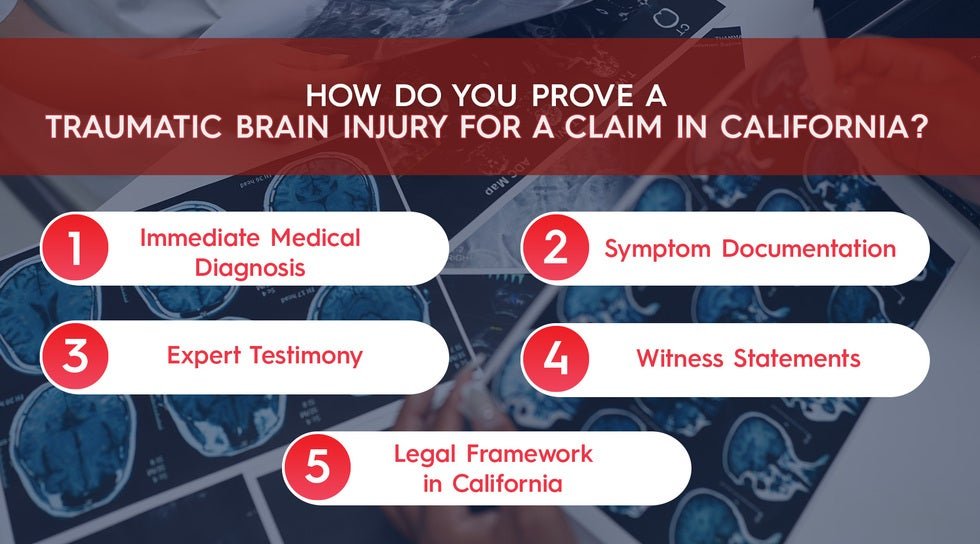
Here are the key elements used to prove a TBI claim in California:
1. Immediate Medical Diagnosis
An injured person should obtain emergency room records, CT scans, and MRIs as crucial early evidence of brain trauma. In more complex cases, advanced tools like DTI scans or neuropsychological exams may be needed to measure memory and cognitive changes.
2. Symptom Documentation
A detailed record of ongoing symptoms, such as headaches, dizziness, mood swings, or “brain fog” helps establish the injury’s impact on daily life. Even mild TBIs can affect work, relationships, and independence.
3. Expert Testimony
Specialists such as neurologists, neuropsychologists, and rehabilitation experts explain the medical consequences of the injury. Their testimony strengthens your case when insurance companies try to minimize or deny your claim.
4. Witness Statements
Family members, friends, and coworkers can testify about noticeable changes in your personality, memory, or abilities since the accident. These personal accounts often resonate strongly with juries.
5. Legal Framework in California
Under California Civil Code § 3333, victims may recover compensation for both economic and non-economic damages. California’s comparative negligence rule means your recovery can be reduced if you are found partly at fault, making legal representation essential.
What Symptoms and Signs Help Prove a TBI Claim?
One of the biggest challenges in brain injury cases is that the symptoms are not always visible. A person may walk away from a crash or fall appearing fine, only to develop serious problems days later. Documenting these changes is essential when building a strong TBI claim in California.
Here are the most common symptoms lawyers and doctors rely on to prove the effects of a traumatic brain injury:
Physical symptoms: persistent headaches, dizziness, blurred vision, fatigue, sleep problems.
Cognitive symptoms: memory loss, difficulty concentrating (“brain fog”), slowed thinking, poor decision-making.
Emotional & behavioral symptoms: mood swings, anxiety, depression, withdrawal from activities, personality changes, sensitivity to stress.
Can You Sue for a Brain Injury in California?
Yes, you can file a traumatic brain injury lawsuit in California if your injury was caused by another party’s negligence:
Legal right to sue: Covered under California Civil Code § 3333 for both economic and non-economic damages.
Statute of limitations: You generally have two years from the date of injury to file a lawsuit.
Comparative negligence: Your compensation can be reduced if you were partly at fault for the accident.
Insurance defenses: Companies may argue your symptoms are exaggerated or pre-existing strong evidence and expert testimony are critical.
At Fassonaki Law Firm, P.C., we know how to fight these defenses and protect your right to full compensation. For accident-related claims, also review: Common Mistakes to Avoid After a Car Accident.
What Compensation Can You Claim for a Traumatic Brain Injury in California?
In California, you can claim various economic and non-economic damages for a traumatic brain injury (TBI), including medical expenses, lost wages, future care costs, pain and suffering, and loss of enjoyment of life. Compensation amounts vary significantly, from tens of thousands for mild concussions to millions for severe, permanent TBI cases. Victims of traumatic brain injuries may recover several types of damages under California law:
Economic damages
Emergency treatment, hospital stays, and surgeries
Rehabilitation and long-term medical care
Prescription medications and therapy costs
Lost wages and reduced future earning capacity
Estimated range: $50,000 – $700,000+, depending on severity
Non-economic damages
Pain and suffering caused by ongoing physical and emotional challenges
Anxiety, depression, and cognitive changes affecting daily life
Loss of enjoyment of life, hobbies, and independence
Strain on family relationships
Estimated range: $100,000 – $1,000,000+ for moderate to severe TBIs
Punitive damages
Awarded in rare cases of gross negligence or intentional misconduct, such as drunk driving or reckless behavior
These damages can significantly increase compensation in catastrophic cases
The estimated ranges provided above are for general informational purposes only and are not fixed or guaranteed. Every TBI claim is unique, and the final compensation amount can vary significantly based on factors like the available insurance coverage, the specific court jurisdiction, and the strength of the evidence.
To get the most accurate and personalized estimate of your potential claim value, we urge you to review your case directly with our personal injury lawyer in a confidential consultation.
Why Is It Hard to Prove a TBI in Court?
Even with strong medical evidence, proving a traumatic brain injury in California courts presents unique challenges:
Invisible injuries: Unlike broken bones, TBIs often do not show up clearly on standard imaging, making them harder to prove.
Delayed symptoms: Headaches, dizziness, memory loss, or mood changes may appear days or weeks after the accident, giving insurers grounds to question the cause.
Insurance company defenses: Insurers often argue that symptoms are exaggerated, caused by pre-existing conditions, or unrelated to the accident.
Subjective complaints: Many TBI symptoms, such as fatigue, confusion, or “brain fog”—rely on the victim’s testimony, which can be challenged as unreliable.
Expert testimony required: Courts often demand neurologists, neuropsychologists, and other specialists to explain the impact of the injury in technical detail.
Because of these hurdles, working with an experienced TBI attorney is critical to building a strong case and countering insurance company strategies.
Speak with Our Traumatic Brain Injury Lawyer in Los Angeles
A traumatic brain injury can change your life in an instant. You should not have to fight insurance companies while dealing with medical bills, lost income, and recovery. The right TBI attorney in Los Angeles can help you prove your case and pursue the full compensation you deserve.
At Fassonaki Law Firm, P.C., we combine medical insight with proven legal strategies to hold negligent parties accountable. We fight hard for our clients and stand by their side from consultation to settlement or trial.
Call 323-524-8994 today for a free case review. We’ll listen to your story, explain your options, and start building a strong claim, because your recovery and future matter.
Frequently Asked Questions (FAQs) About Proving a TBI Claim in California
How do you prove you have a traumatic brain injury (TBI)?
You must first prove that you suffered an injury through medical documentation. Emergency room records, CT scans, MRIs, and neuropsychological exams create a paper trail that links your symptoms to the accident. Expert testimony from neurologists or neuropsychologists can also strengthen your case.
What are the diagnostic criteria for TBI?
Doctors may diagnose TBI using the Glasgow Coma Scale, imaging tests like CT or MRI scans, and neuropsychological evaluations. Symptoms such as memory loss, confusion, headaches, and mood changes are also important in confirming the diagnosis.
How do you prove a TBI in a lawsuit?
To prove a TBI in court, you need strong evidence, including medical records, test results, expert testimony, and witness statements from family or coworkers who observed changes in your behavior. This evidence demonstrates both the injury itself and its impact on your daily life.
What is the average settlement for a TBI in California?
Settlement amounts vary depending on the severity of the injury. Mild TBIs or concussions may settle for around $50,000 to $200,000, moderate TBIs often range between $200,000 and $700,000, and severe or permanent brain injuries can exceed $1 million. Factors such as medical costs, lost wages, and long-term care influence the final amount.
Why is it hard to prove a TBI in court?
TBIs are often considered “invisible injuries.” Symptoms may be delayed, subtle, or subjective, which allows insurance companies to dispute their seriousness. Proving a TBI usually requires medical experts, detailed records, and strong legal representation.
Do I need a lawyer to file a TBI claim in California?
Yes, because TBIs involve complex medical and legal issues, having an experienced traumatic brain injury lawyer in Los Angeles is essential. A lawyer can gather expert testimony, negotiate with insurance companies, and present a strong case in court.