
Most accident victims search for answers like “How long do I have to sue?”, “What documents do I need?”, or “Do I need a lawyer to file a car accident lawsuit in California?” This guide covers every step, timeline, piece of evidence, legal requirement, and real California regulation so you know exactly what to do next.
Speaking with a personal injury lawyer Los Angeles early can help you avoid costly mistakes and protect your right to compensation.
If you need immediate guidance, you can reach our Los Angeles car accident lawyer at 323-524-8994 for a free consultation.
Step-by-Step Guide: How to File a Car Accident Lawsuit in California
Filing a car accident lawsuit in California may sound overwhelming, but the legal process becomes much easier when you understand each step. Below, we break it down in simple terms so you know exactly what to expect and when.
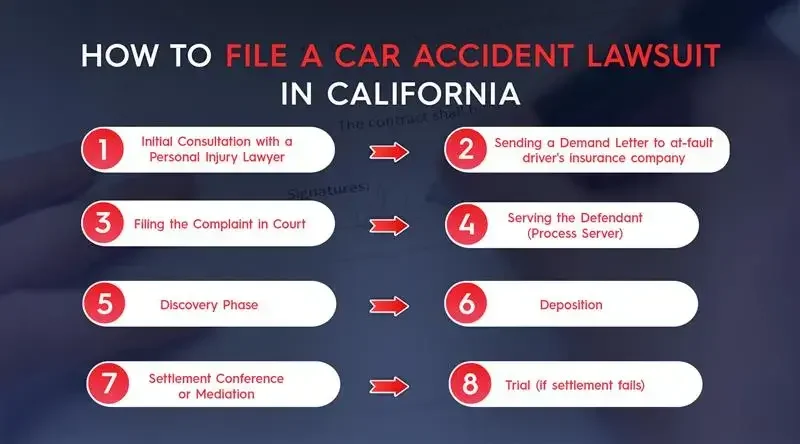
1. Initial Consultation with a Personal Injury Lawyer
Your first step is to speak with a California car accident lawyer. During this free consultation, the lawyer will review your case details, medical records, and accident report to determine whether you have a valid claim. They’ll also explain how contingency fee agreements work, which means you don’t pay unless we win your case.
If you’re unsure whether your injuries qualify for a lawsuit, call 323-524-8994 to speak with a Los Angeles car accident lawyer today.
2. Sending a Demand Letter
If your case is strong, your attorney prepares and sends a demand letter outlining:
Your injuries
Medical bills
Lost wages
Pain and suffering
Property damage
Settlement amount requested
This letter outlines your injuries, property damage, medical bills, and the compensation you’re seeking. The goal is to settle your car accident claim without filing a lawsuit, but if the insurer denies or lowballs the claim, the next step is to file a lawsuit.
3. Filing the Complaint in Court
When negotiations fail, your attorney will file a legal complaint in civil court to start your lawsuit. This complaint names the defendant and explains how their negligence caused your injuries under California law (Civil Code §1714(a)). At this point, the court will issue a summons, which must be served on the defendant.
4. Serving the Defendant (Process Server)
A process server delivers the summons and complaint to the at-fault party, officially notifying them of the lawsuit. This is a critical legal step in the California civil litigation process. Once served, the defendant typically has 30 days to respond.
What Happens After a Car Accident Court Summons in California?
If you were just served with a car accident court summons in California, do not ignore it. The next steps you take affect your credit, your license, and even your wages. Here’s exactly what to do.
What to Do Immediately After Being Served
Read the summons and complaint carefully. Confirm who is suing you, what they are claiming, and your exact response deadline.
Calendar your deadline. In most California civil cases, you have 30 days from the date you were served to file a response.
Contact your auto insurance company right away. Send your insurance company a copy of the summons and complaint. Your insurer must provide a defense if the claim is covered.
Do not contact the other driver or admit fault. Anything you say can be used against you.
Talk to a California car accident attorney. Our Los Angeles car accident lawyer can help you file the correct response and protect you from default judgment.
Have questions about the car accident complaint process? Call 323-524-8994 for free legal guidance.
5. Discovery Phase
Once both parties are involved, the case enters discovery. During this phase, your attorney and the defense exchange evidence: medical records, crash reports, photos, and witness statements. You may also answer written questions (interrogatories) or provide testimony under oath.
6. Deposition
A deposition is where you, the defendant, or witnesses give verbal testimony under oath in front of a court reporter. It’s not in court, but your statements can be used later at trial. Your attorney will prepare you ahead of time so you feel confident and ready.
Pro Tip:
Most deposition testimony pressures insurers to increase their settlement offers once they see strong credibility.
7. Settlement Conference or Mediation
Before trial, the court often schedules a settlement conference to try to resolve the case. In many car accident lawsuits, both sides reach a negotiated settlement at this stage. If not, the case proceeds to trial.
8. Trial
If settlement efforts fail, your case goes to trial. Here, both sides present evidence, call witnesses, and let a judge or jury decide the outcome. While most personal injury lawsuits in California settle before trial, being prepared is key.
Want to see how these steps lead to real results?
Check out our case results to learn how Fassonaki Law Firm has helped car accident victims throughout California recover the compensation they deserve.
Can You File a Car Accident Lawsuit in California
After getting into a car accident, everyone’s first concern is, can I actually file a lawsuit? The answer depends on several factors, like who was at fault, how serious your injuries are, and what kind of compensation you need. Here’s a breakdown to help you understand if pursuing legal action makes sense for your situation.
When Can You Use Small Claims Court for a Car Accident in California?
Not every California car accident needs a full civil lawsuit. Sometimes the dispute is small, the injuries are minor, and the insurance company refuses to cooperate. In those situations, small claims court can be a faster and more affordable way to resolve your car accident claim.
Small claims is designed for simple disputes. It works best when:
Property damage is low. Example: minor bumper damage, paint scratches, or low-cost repairs under a few thousand dollars.
Your medical bills are minimal. This applies when injuries are mild and treatment is limited to a quick urgent-care visit.
You have a deductible or repair cost dispute with the other driver or their insurance company.
The amount you’re seeking fits California’s small claims court monetary limits. (High-level note: individuals can sue for several thousand dollars.)
These cases usually don’t require the full process of filing a car accident lawsuit in California, which saves you time and money.
Who Can File a Car Accident Lawsuit in California?
Under the California Civil Code and California Vehicle Code, you can file a car accident lawsuit if another driver’s negligence caused your injuries or property damage. California is a fault-based state, meaning the at-fault party (or their insurance company) is responsible for paying damages.
Even if you were partially at fault, you may still be eligible to recover compensation. Thanks to California’s comparative negligence rule, your recovery will just be reduced by your percentage of fault. For example, if you were 20% at fault, you could still recover 80% of your total damages.
Minor vs. Major Accidents: Does Severity Matter?
Yes, it does. If your accident involved only minor vehicle damage and no injuries, you may not need to file a lawsuit; you can often settle through insurance or even small claims court.
However, if you suffered:
Broken bones
Concussions or whiplash
Long-term pain or disability
Loss of income from time off work
Then a lawsuit may be the best way to recover fair compensation for your losses. These rules apply whether the accident happened in Los Angeles, Orange County, or anywhere in California, because the state follows a fault-based system for all motor vehicle collisions.
Do You Still Need to File a Car Accident Lawsuit if You Have MedPay Coverage?
If you have MedPay (Medical Payments Coverage) through your auto insurance, it may cover some immediate medical costs, regardless of who was at fault. But MedPay has limits and doesn’t compensate for pain, emotional distress, or long-term damage. A lawsuit allows you to pursue full compensation.
When Should You Talk to a Personal Injury Lawyer for Your Car Accident Case?
If you’re unsure whether your case is “big enough,” it’s still smart to consult with a personal injury lawyer. Most offer free consultations and work on a contingency fee basis, meaning they only get paid if they win your case. A lawyer can also help you avoid lowball settlement offers from the insurance company.
Need help figuring out your next step? Talk to a car accident lawyer in Los Angeles at Fassonaki Law Firm P.C., today.
How Long Do You Have to File a Car Accident Lawsuit in California?
California’s Statute of Limitations for Car Accident Claims gives most injured victims two years from the date of the crash to file a personal injury lawsuit. If you miss this deadline, you lose your right to pursue compensation, no exceptions, even if the other driver was clearly at fault.
For property-damage-only claims, the deadline is three years. Because evidence fades and insurance companies delay, acting early helps protect your case, preserves key proof, and increases your chances of a fair recovery. If you’re unsure how much time you have left, a California car accident lawyer can guide you before the window closes.
Here’s a clear breakdown of how long you have to file a car accident lawsuit in California and why acting early matters.
|
Type of Claim |
California’s Statute of Limitations |
|
Personal Injury |
2 Years (CCP § 335.1) |
|
Property Damage |
3 Years (CCP § 338) |
|
Government Entity |
6 Months (Administrative Claim) (Gov. Code § 911.2) |
|
Uninsured Motorist (UM) Claim |
2 Years under Insurance Code § 11580.2(i)(1)(C) |
|
Underinsured Motorist (UIM) Claim |
Within “a reasonable time” after exhaustion of the claims against the underinsured |
1. Statute of Limitations for Personal Injury Claims of Car Accident: 2 Years (CCP § 335.1)
Under California Code of Civil Procedure § 335.1, you have two years from the date of your car accident to file a personal injury lawsuit. This includes claims for:
Neck or back injuries
Concussions or brain trauma
Whiplash
Broken bones
Emotional distress
This deadline applies whether you were a driver, passenger, pedestrian, or cyclist. If you miss the two-year mark, the court will almost always dismiss your case, even if your injuries are severe.
2. Statute of Limitations for Property Damage Claims: 3 Years
If you’re only filing a claim for vehicle damage, you get a little more time of three years from the date of the crash, under California Code of Civil Procedure § 338.
This could apply to cases where:
Your car was totaled or severely damaged
You are filing a diminished value claim
You weren’t injured, but still suffered financial loss
3. Claims Against a Government Entity: Just 6 Months
If your accident involved a government-owned vehicle or occurred due to dangerous public property, the deadline to act is much shorter. Under California Government Code § 911.2, you must file a mandatory administrative claim with the responsible government agency within six months of the accident.
This six-month period is not the statute of limitations for filing a lawsuit; it is a prerequisite you must meet before you are allowed to sue. Missing this step almost always means you lose the right to pursue your case, even if the normal two-year personal injury deadline has not expired.
Once your administrative claim is submitted:
If the government entity formally rejects it, you have six months from the date of the rejection notice to file a lawsuit in court.
If the entity does not respond within 45 days, your claim is considered denied “by operation of law,” and you have two years from the accident date to sue.
Examples of government-related accident claims include:
Collisions with city buses, police cars, fire trucks, or Caltrans vehicles.
Accidents caused by defective traffic lights, missing road signs, or potholes on public roads.
Why You Shouldn’t Wait to File a Car Accident Lawsuit
Even though the law gives you time, waiting can hurt your case. Here’s why:
Key evidence fades (surveillance footage gets deleted, cars get repaired, memories fade)
Insurance companies delay or deny if you wait too long to pursue a claim
Strict deadlines for uninsured motorist (UM) claims: Under Insurance Code § 11580.2(i)(1)(C), you must demand arbitration or file a lawsuit within 2 years of the accident to preserve your right to UM benefits. This deadline is absolute, and missing it may bar your claim.
Underinsured motorist (UIM) claims have a flexible but limited window: While there’s no fixed statute of limitations for UIM claims, you’re still required to act within a reasonable time after settling with the underinsured driver. Courts may deny your claim if there’s unjustified delay.
What Documents and Evidence Do You Need to File a Car Accident Lawsuit in California
Having complete and accurate documents is more than just a formality; it shows insurers and courts that your injuries and damages are real. Many of our clients have shared how grateful they were to have expert guidance through the process. Read their stories in our client testimonials
Here’s what you’ll need and why each piece matters:
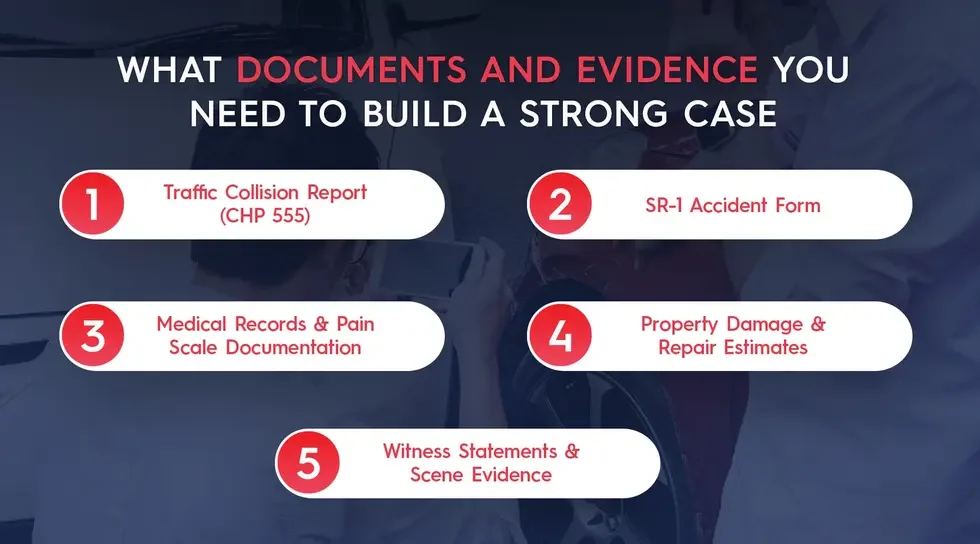
1. Traffic Collision Report (CHP 555)
This is one of the most critical documents in any California car accident lawsuit. Created by the California Highway Patrol (CHP) or the local police, this report includes key details like:
Who was involved
Officer’s observations
Diagrams of the accident scene
Any citations issued
You can request a copy through the CHP Public Records Request Portal. This official report can support your claim and help establish liability, especially in cases involving a red light violation or DUI.
2. SR-1 Accident Form
Suppose your accident resulted in injuries, death, or property damage over $1,000. In that case, you are legally required to submit the SR-1 form to the California DMV within 10 days, even if law enforcement was present. This step is often overlooked, but failing to file can negatively impact your insurance coverage and injury claim.
3. Medical Records & Pain Scale Documentation
Accurate and detailed medical records are essential in proving the severity of your injuries. From ER visits to physical therapy, every diagnosis, imaging report, and prescription should be documented. It’s also helpful to track your pain using a standardized pain scale, which shows how the injury has affected your daily life over time.
4. Property Damage & Repair Estimates
Insurance companies often downplay vehicle damage, but repair estimates can be powerful when negotiating the diminished value of your car or demonstrating impact severity. Include:
Photos of the damage
Mechanic evaluations
Total loss letters (if applicable)
5. Witness Statements & Scene Evidence
If anyone saw the accident, their statement can strengthen your case. Eyewitness testimony helps confirm your side of the story, especially if fault is disputed. Also save:
Photos/videos of the scene
Dashcam footage (if available)
Time/date-stamped weather or traffic conditions
If you’re not sure where to start, our legal team can help you gather and organize this evidence.
What You Can Claim in a Car Accident Lawsuit
When you file a car accident lawsuit in California, one of the biggest questions on your mind is likely, “How much compensation can I recover?” The answer depends on the types of damages you’ve suffered, both physically and financially.
Under California Civil Code § 1431.2, juries are instructed to separate economic and non-economic damages in their verdicts. This helps ensure your compensation reflects both the actual expenses and the true impact on your quality of life.
Let’s break them down:
1. Economic Damages: Tangible Financial Losses
These are losses you can calculate based on actual bills and documentation. If your accident left you with expenses or reduced income, these fall under economic damages:
Medical bills: ER visits, surgery, physical therapy, chiropractic care, medications, and more
Lost wages: Income you missed while recovering, plus loss of future earning capacity if your injuries affect long-term work
Property damage: Repair or replacement costs for your car, including diminished value claims
Future medical care: Ongoing treatments, follow-up appointments, rehab, or in-home care
If you used Medical Payments Coverage (MedPay) from your insurance to cover some bills, you may still sue the at-fault party for additional expenses not covered under your policy.
2. Non-Economic Damages: Pain, Suffering & Emotional Toll
These damages are just as real but harder to put a number on. They address the physical pain and emotional distress you’ve endured due to the accident:
Pain and suffering: Chronic pain, discomfort, or trauma affecting your daily life
Loss of consortium: If the accident has affected your relationship with your spouse or family
Emotional distress: Anxiety, depression, PTSD, or fear of driving again
Factors That Affect the Value of Your California Car Accident Lawsuit
Every car accident case is different, and your compensation depends on several key factors.
Severity and type of injuries: More serious injuries (fractures, herniated discs, concussions, long-term impairment) generally result in higher compensation than minor soft-tissue injuries.
Length and type of medical treatment: Extended treatment such as physical therapy, specialist care, surgeries, pain management, or future medical needs increases your case value.
Whether your injuries cause permanent limitations : Ongoing pain, limited mobility, scarring, disability, or long-term medical needs significantly raise the value of your claim.
Your lost wages and future earning capacity: If your injuries prevent you from working, reduce your hours, or affect your future income, these financial losses increase your total recoverable damages.
Insurance policy limits and strength of liability evidence: The clearer the evidence of fault (photos, witness statements, crash reports), the stronger your case. Additionally, the available insurance policy limits often determine how much you can realistically recover.
Every case is different; call 323-524-8994 for a free, personalized evaluation from a Los Angeles car accident lawyer.
Do You Need a California Car Accident Lawyer for Your Lawsuit
If you’re recovering from a car accident in California and dealing with insurance companies, bills, or medical treatment, you’re probably wondering, “Do I really need a lawyer?” The short answer is having a personal injury attorney on your side can significantly improve your chances of a successful settlement.
In many cases, insurance companies are quick to offer low settlements, especially if you’re not legally represented. They often hope you’ll accept an offer before understanding the full value of your claim, including future medical expenses or pain and suffering. A car accident lawyer knows how to push back and negotiate with insurance adjusters.
What Is the Process to Sign Up for a Free Car Accident Case Consultation
At Fassonaki Law Firm P.C., we offer a free consultation to review your case and walk you through your legal options. If you’re not sure whether you need a lawyer or if your claim qualifies, don’t guess; speak with a professional car accident lawyer in Los Angeles at 323-524-8994.
Frequently Asked Questions About Filing a Car Accident Lawsuit in California
How long does a car accident lawsuit take in California?
There’s no fixed timeline; many cases settle within 6-12 months, but if a lawsuit is filed and a trial is required, it can take 18-24 months (or more) depending on how many parties are involved, how complex the injuries are, and how busy the court is. Your Fassonaki Law Firm P.C. lawyer can estimate based on similar California cases.
Can I sue if I was partly at fault for the crash in California?
Yes! California uses a comparative negligence rule, which means you can still recover damages even if you had some fault. For example, if you were found 20% at fault, you could still recover 80% of the total damages. Your final recovery will be reduced by your percentage of fault.
Do I have to go to court for a California car accident lawsuit?
Not always. Most car accident claims in California are resolved before trial through settlement or mediation. However, your case could go to court if a fair settlement cannot be reached, if liability is strongly disputed, or if the value is high. Your attorney will prepare you and let you know when a trial is actually needed.
What happens if the insurance company denies my claim?
If your claim is denied, you still may have options: you can gather additional evidence, appeal the decision, file a lawsuit against the at-fault driver (and possibly their insurer), or pursue your own uninsured/underinsured motorist (UM/UIM) coverage. It’s important to act quickly because of deadlines under California law.
Do I need a lawyer to file a car accident lawsuit in California?
Legally, you can file on your own, but having a qualified California car accident attorney significantly improves your chances of recovery. Lawyers know how to handle settlement negotiations, navigate court procedural rules, protect your rights, and often secure higher compensation.
What if my injuries appeared days after the accident in California?
Late-manifesting injuries are common (like whiplash or concussion). The key is to start treatment as soon as you notice symptoms and link them to the accident. While the statute of limitations still applies, delaying treatment or silence can weaken your case.
How much is my California car accident case worth?
There is no standard number each case depends on the severity of injuries, medical costs, lost wages, long-term impact, liability strength, insurance policy limits, and whether you’re partly at fault. Your attorney can review your details and give you a realistic estimate
(This blog post is intended for general informational purposes only and does not constitute legal advice. If you need legal assistance, please contact a qualified attorney. Any references to laws or cases are for context only and do not serve as legal interpretation. Past results are not a guarantee or warranty of future outcomes. No attorney-client relationship is formed here.)